
The Thirty-one Planes of Existence
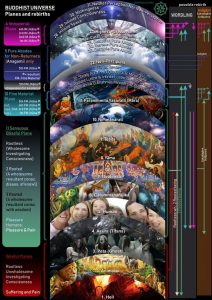
Scattered throughout the suttas are references to as many as thirty-one distinct „planes“ or „realms“ of existence into which beings can be reborn during their long wandering through samsara. These range from the extraordinarily grim and painful hell realms all the way up to the most exquisitely refined and blissful heaven realms. Existence in every realm is temporary; in Buddhist cosmology there is no eternal heaven or hell. Beings are born into a particular realm according to their past kamma. When they pass away, they take rebirth once again elsewhere according to the quality of their kamma: wholesome actions bring about a favorable rebirth, while unwholesome actions lead to an unfavorable one. And so the wearisome cycle continues.
The realms of existence are customarily divided into three distinct „worlds“ (loka), listed here in descending order of refinement:
- The Immaterial World (arupa-loka). Consists of four realms that are accessible to those who pass away while meditating in the formless jhanas.
- The Fine-Material World (rupa-loka). Consists of sixteen realms whose inhabitants (the devas) experience extremely refined degrees of mental pleasure. These realms are accessible to those who have attained at least some level of jhana and who have thereby managed to (temporarily) suppress hatred and ill-will. They are said to possess extremely refined bodies of pure light. The highest of these realms, the Pure Abodes, are accessible only to those who have attained to „non-returning,“ the third stage of Awakening. The Fine-Material World and the Immaterial World together constitute the „heavens“ (sagga).
- The Sensuous World (kama-loka). Consists of eleven realms in which experience — both pleasurable and not — is dominated by the five senses. Seven of these realms are favorable destinations, and include our own human realm as well as several realms occupied by devas. The lowest realms are the four „bad“ destinations, which include the animal and hell realms.
The information on this page was assembled from a variety of sources. In the interests of economizing space I have not attributed each fact to its respective source.

Realms of existence
- Purgatory (Hells, but impermanent, not eternal)
- Asuras (jealous beings)
- Ghosts
- Animals
- Humans
- Higher Beings (the six planes within sense world, consisting of angels or impermanent gods)
The above lists a summary of the Buddha’s cosmology. All are closely interdependent as beings progress through the various realms of existence.
In addition to the six major levels of the planes of existence listed above, there are 16 planes of heavenly beings outside the sense world (the world of Form) and another 4 planes of heavenly beings in the Formless world (without body) for a total of 31 planes of existence. In the planes of existence we can see our close connection to animals. This is from the re-birth process and the fact that animals, like humans suffer from emotions, selfish cravings, and other pleasant and unpleasant sensations. Darwin’s theory of evolution is completely compatible with Buddhism.
The 31 planes of existence
Lifespan listed is in our earth years, for the devas their celestial days and years are different from our concepts of time, similar to how different planets and solar systems have different number of hours in a day, year, etc.
I. The Sensuous World (kama-loka)
States of deprivation (apaya)
Niriya, naraka: These are realms of unimaginable suffering and anguish (described in graphic detail in MN 129 and MN 130). Should not be confused with the eternal hell found in other religious traditions, since one’s time here is — as it is in every realm — temporary.
Cause of rebirth here: Ten unwholesome actions (Majjhima Nikaya 41), Lack of virtue, holding to wrong views (Anguratta Nikaya 10.177), Murdering your parents, murdering an arahant, injuring the Buddha, or creating a schism in the Sangha (Anguratta Nikaya 5.129), Being quarrelsome and annoying to others (Snp II.6)
Animals: This realm includes all the non-human forms of life that are visible to us under ordinary circumstances: animals, insects, fish, birds, worms, etc.
Cause of rebirth here: Ten unwholesome actions (MN 41), Lack of virtue, holding to wrong views. If one is generous to monks and nuns, however, one may be reborn as an „ornamented“ animal (i.e., a bird with bright plumage; a horse with attractive markings, etc.; AN 10.177). Behaving like an animal (MN 57)
Hungry Ghost: Ghosts and unhappy spirits wander hopelessly about this realm, searching in vain for sensual fulfillment.
Read Ajaan Lee’s colorful description of this realm.
Cause of rebirth here: Ten unwholesome actions (MN 41), Lack of virtue, holding to wrong views (AN 10.177)
Asura: The halfdevas „titans“, that dwell here are engaged in relentless conflict with each other.
Cause of rebirth here: · Ten unwholesome actions (MN 41)
| No. | Realm | Pali | Life-span | Cause of rebirth here |
|---|---|---|---|---|
| 1 | Purgatory | niriya, naraka | varies | unwholesome actions, murdering parents or arahant, injuring arahant, creating schism |
| 2 | Asuras | asura | varies | unwholesome actions |
| 3 | Hungry ghosts | peta loka | varies | unwholesome actions, lack of virtue |
| 4 | Animals | tiracchana yoni | varies | unwholesome actions, behaving like an animal |
Happy Destinations (sugati)
Numbers 5 – 11 are in the realm of the sense world, can experience sense pleasures and displeasures, mostly pleasure for the devas (impermanent gods or angels).
You are here (for now).
Rebirth as a human being is extraordinarily rare (SN 56.48). It is also extraordinarily precious, as its unique balance of pleasure and pain (SN 35.135) facilitates the development of virtue and wisdom to the degree necessary to set one free from the entire cycle of rebirths. Cause of Rebirth here: The development of virtue and wisdom (AN 10.177), The attainment of stream-entry (sotapatti) guarantees that all future rebirths will be in the human or higher realms.
Home of the gandhabbas, the celestial musicians, and the yakkhas, tree spirits of varying degrees of ethical purity. The latter are analogous to the goblins, trolls, and fairies of Western fairy tales.
Sakka, a devotee of the Buddha, presides over this realm. Many devas dwelling here live in mansions in the air.
These devas live in the air, free of all difficulties.
A realm of pure delight and gaiety. Bodhisattas abide here prior to their final human birth. This is where the bodhisatta Maitreya (Metteya), the next Buddha, is said to dwell.
These devas delight in the sense objects of their own creation.
These devas enjoy sense pleasures created by others for them. Mara, the personification of delusion and desire, lives here.
Cause of Rebirth here: Ten wholesome actions (MN 41), Generosity, The development of virtue and wisdom (AN 10.177)
| No. | Realm | Pali | Life-span | Cause of rebirth here |
|---|---|---|---|---|
| 5 | Humans | manussa loka | varies, approx. 10 to 120 years | development of virtue, wisdom, stream-entry guarantees rebirth as human or deva |
| 6 | Devas of the Four Great Kings | catumaharajika deva | 9 million years | wholesome actions, virtue, generosity, wisdom |
| 7 | The 33 gods | tavatimsa deva | 36 million years | wholesome actions, virtue, generosity, wisdom |
| 8 | Yama devas | yama deva | 144 million years | wholesome actions, virtue, generosity, wisdom |
| 9 | Contented devas | tusita deva | 576 million years | wholesome actions, virtue, generosity, wisdom |
| 10 | Devas delighting in creation | nimmanarati deva | 2.3 billion years | wholesome actions, virtue, generosity, wisdom |
| 11 | Devas wielding power over others’ creations | paranimmita-vasavatti deva | 9.2 billion years | wholesome actions, virtue, generosity, wisdom |
II. The Fine-Material World (rupa-loka)
Numbers 12 – 27 are in the realm of form. There is a subtle body and these deva realms are superior to those in the sense realm. One attains rebirth to these planes based on kamma and spiritual attainments.
Beings in these planes enjoy varying degrees of jhanic bliss.
One of this realm’s most famous inhabitants is the Great Brahma, a deity whose delusion leads him to regard himself as the all-powerful, all-seeing creator of the universe (DN 11).
Beings in these planes enjoy varying degrees of jhanic bliss.
Only body is present; no mind.
Among its inhabitants is Brahma Sahampati, who begs the Buddha to teach Dhamma to the world (SN 6.1).
These are the five Pure Abodes (suddhavasa), which are accessible only to non-returners (anagami) and arahants. Beings who become non-returners in other planes are reborn here, where they attain arahantship.
Cause of Rebirth here First to Fourth jhana. (See, e.g., AN 4.123. Jhana Sutta: Mental Absorption (1) )
| No. | Realm | Pali | Life-span | Cause of rebirth here |
|---|---|---|---|---|
| 12 | Retinue of Brahma | brahma-parisajja deva | one-third of an aeon | proficiency in first jhana, minor degree |
| 13 | Ministers of Brahma | brahma-purohita deva | half an aeon | proficiency in first jhana, medium degree |
| 14 | Great Brahmas | Maha brahma | one aeon | proficiency in first jhana, highest degree |
| 15 | Devas of limited radiance | parittabha deva | 2 aeons | proficiency in second jhana, minor degree |
| 16 | Devas of unbounded radiance | appamanabha deva | 4 aeons | proficiency in second jhana, medium degree |
| 17 | Devas of streaming radiance | abhassara deva | 8 aeons | proficiency in second jhana, highest degree |
| 18 | Devas of limited glory | parittasubha deva | 16 aeons | proficiency in third jhana, minor degree |
| 19 | Devas of unbounded glory | appamanasubha deva | 32 aeons | proficiency in third jhana, medium degree |
| 20 | Devas of refulgent glory | subhakinna deva | 64 aeons | proficiency in third jhana, highest degree |
| 21 | Very fruitful devas | vehapphala deva | 500 aeons | proficiency in fourth jhana |
| 22 | Unconscious beings | asaññasatta | 500 aeons | proficiency in fourth jhana |
Realms 23 to 27 are the Pure Abodes (suddhavasa), which are accessible only to non-returners (anagami) and arahants. Beings who become non-returners in other planes are reborn here, where they attain arahantship. Among its inhabitants is Brahma Sahampati, who begs the Buddha to teach Dhamma to the world (Samyutta Nikaya 6.1). Cause of Rebirth here Fourth jhana. (See, e.g., AN 4.123. Jhana Sutta: Mental Absorption (1))
| No. | Realm | Pali | Life-span | Cause of rebirth here |
|---|---|---|---|---|
| 23 | Devas not falling away | aviha deva | 1,000 aeons | proficiency in fourth jhana |
| 24 | Untroubled devas | atappa deva | 2,000 aeons | proficiency in fourth jhana |
| 25 | Beautiful, clearly visible devas | sudassa deva | 4,000 aeons | proficiency in fourth jhana |
| 26 | Clear-sighted devas | sudassi deva | 8,000 aeons | proficiency in fourth jhana |
| 27 | Peerless devas | akanittha deva | 16,000 aeons | proficiency in fourth jhana |
III. The Immaterial World (arupa-loka)
Numbers 28 – 31 are in the realm of the formless. This means there is no body of any kind. There is just a type of consciousness, conventional existence as we know it, but without a body. The life spans are very long in the formless realm and one attains to these levels by the formless jhanas these planes are named after, jhanas or realms 5 to 8. Numbers 28- 31 are not necessarily the best places to be. At these levels, one cannot hear the Dhamma from a Buddha or arahant on earth or any other planet.
The best destinations are the pure abodes at numbers 23 – 27 which are deva realms for non-returners. Rebirth to these planes means that enlightenment will be attained while at one of these planes of existence.
| No. | Realm | Pali | Life-span | Cause of rebirth here |
|---|---|---|---|---|
| 28 | Sphere of Infinity of Space | akasanañcayatanupaga deva | 20,000 aeons | proficiency in fifth jhana (the first formless jhana) |
| 29 | Sphere of Infinity of Consciousness | viññanañcayatanupaga deva | 40,000 aeons | proficiency in sixth jhana (the second formless jhana) |
| 30 | Sphere of No-thingness | akiñcaññayatanupaga deva | 60,000 aeons | proficiency in seventh jhana (the third formless jhana) |
| 31 | Sphere of Neither Perception nor Non-Perception | nevasaññanasaññayatanupaga | 84,000 aeons | proficiency in eighth jhana (the fourth formless jhana) |
Sources:
- Buddhist Dictionary, by Nyanatiloka Mahathera (Kandy: Buddhist Publication Society, 1980).
- The Buddhist Religion: A Historical Introduction (fourth edition), by R.H. Robinson & W.L. Johnson (Belmont, California: Wadsworth, 1997).
- The Long Discourses of the Buddha (Introduction), translated by Maurice Walshe (Boston: Wisdom Publications, 1987).
- A Manual of Abhidhamma, by Ven. Narada Thera (Kuala Lumpur: Buddhist Missionary Society, 1979).
- The Middle Length Discourses of the Buddha (Introduction), translated by Bhikkhu Ñanamoli and Bhikkhu Bodhi (Boston: Wisdom Publications, 1995).
- Teacher of the Devas (Wheel Publication 414/416), by Susan Elbaum Jootla (Kandy: Buddhist Publication Society, 1997).
- The Three Worlds (wall chart), compiled by Ven. Acaro Suvanno (printed for free distribution by devotees and Mr & Mrs Lim Say Hoe and family).
- Bhante Anandajoti: The Planes of Existence https://www.youtube.com/watch?v=GzPIeCaV-is
- 31 Planes of Existence by Suvanno Mahathera. https://urbandharma.org/pdf16/31-planes-of-existence.pdf
- The 31 Planes of Existence by Ven. Suvanno Mahathera https://archive.org/details/The31PlanesOfExistence
- The 31 Planes of Existence by Suvanno Mahathera https://www.holybooks.com/the-31-planes-of-existence/